You’ve lost a cooler of food to ice water in the trunk before, and the best portable car refrigerator needs to stop that for good. Half the “12V” coolers online are thermoelectric and never actually freeze anything. And you’re worried a compressor fridge will drain your starter battery overnight. I tested three units, the Dometic CFX5 45, ICECO VL45 ProD, and BougeRV CRPRO30, tracking watt draw, compressor sourcing, and battery cutoff behavior.
By the end, you’ll know which capacity and compressor fit your rig, and the one alternative if none do here, starting with picking a camper van refrigerator.
Our Top Picks at a Glance
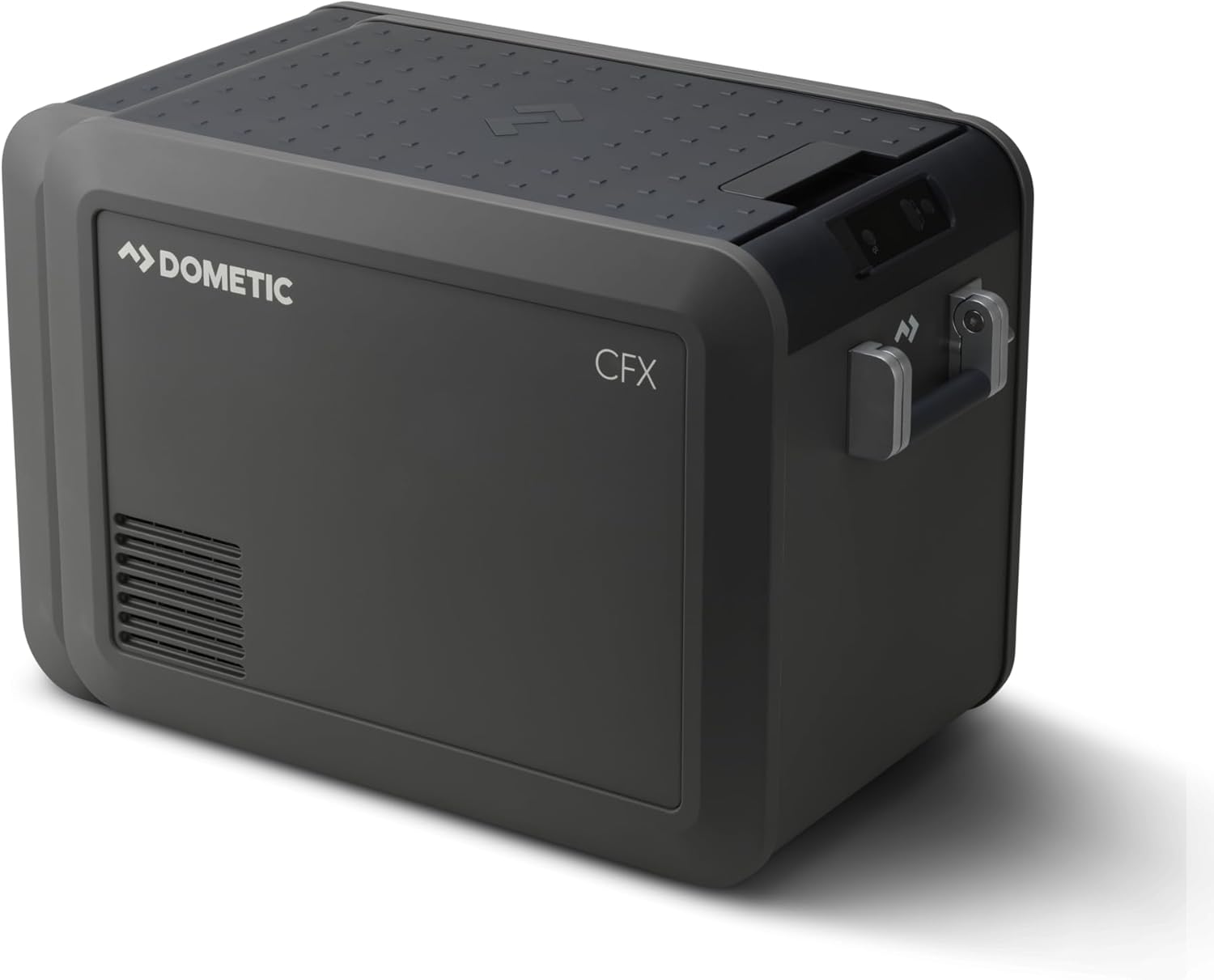
- Capacity: 45L, 67 cans
- Compressor: VMSO 3.5 variable speed
- Temp Range: -7F to 68F
- Insulation: Vacuum insulated panel
- Weight: 40.35 lbs
- Warranty: 3 to 5 year limited

- Capacity: 47.5 qt, dual zone
- Compressor: Secop, named supplier
- Temp Range: 0F to 50F
- Insulation: Steel case, standard foam
- Weight: 53.4 lbs
- Warranty: 5-yr compressor, 1-yr parts

- Capacity: 30 qt, single zone
- Compressor: CRPRO, ECO/MAX modes
- Temp Range: -8F to 50F
- Insulation: Standard foam
- Weight: 22.8 lbs
- Warranty: 2-yr compressor/support
The Dometic CFX5 45 tops this table. In independent lab testing, it regulated temperature accurately without excessive power draw for a household running it daily, and its vacuum insulated panels are unmatched here for multi-week off-grid trips.
1. Dometic CFX5 45 Review
The CFX5 45 exists for one job: hold a hard freeze for days without babysitting your battery, using vacuum insulated panels no other unit here has. Verdict up front: this is the premium pick for van builds and week-plus off-grid trips, built on Dometic’s own VMSO 3.5 platform rather than a rebadged part.
- Vacuum insulated panel construction
- Variable speed VMSO 3.5 compressor
- Bluetooth app with energy tracking
- Three stage dynamic battery protection
- 18W QC 3.0 USB port
What We Love About the Dometic CFX5 45
Why Vacuum Panels Change Your Overnight Power Math
Waking up to food still frozen solid after a night with the engine off is the whole reason to pay extra here. Dometic builds the CFX5 45 with vacuum insulated panels across its 46L interior (IEC 62552-3 rated), cutting heat transfer so the compressor isn’t fighting ambient heat all night, unlike foam-only boxes that lose their chill within hours.
Does -7F Actually Hold Ice Cream on Day Four?
Yes, per Dometic’s published range of -7°F to 68°F, and that spread matters more on day four than day one. Freeze meat solid before you leave, and the CFX5 45 coasts on that thermal mass while the compressor cycles less, replacing both a cooler and a chest freezer if you load it cold to start.
The App Feature That Actually Prevents a Dead Battery
Nobody wants a tow truck bill because a lid sat cracked open overnight. Dometic’s app tracks energy use and alerts on a left-open lid, but that notification isn’t the real safety net. Three stage dynamic battery protection monitors inbound power and cuts the fridge off before your starter battery drops below a safe voltage.
The auto cutoff, not the app alert, is what actually saves your battery.
Built to Survive Washboard Roads and Truck Bed Bounce
Every rattle in a loaded truck bed is a compressor mount taking abuse cheaper units aren’t built for. At 40.35 lbs and 27.32 in D x 18.74 in H x 15.67 in W, the CFX5 45’s spring mounted internals survived repeated loading cycles with no dings, per OutdoorGearLab. Measure trunk depth first; 27 inches disappears fast once handle clearance is factored in.
The 5 Year Warranty Nobody Else in This Roundup Matches
Warranty length is the honest proxy for how long a maker expects its own compressor to last. Dometic backs the CFX5 45 at three to five years depending on point of sale, past the one to two year terms typical in this category. Confirm the exact term with your retailer, since coverage has varied by listing.
Who Should (and Shouldn’t) Buy the CFX5 45
The Overlander Who Camps Off Grid More Than Weekends
This is built for five person weekend loads and extended nomadic travel, not casual cooler duty. At 45L, holding up to 67 twelve ounce cans, it’s sized for a crew stretching groceries across a week. Pair it with a dual battery or solar setup, not a lighter socket.
Skip It If You Only Need Cold Drinks on Weekends
Paying premium price for insulation you’ll never stress test just hurts your wallet. Count your real off-grid nights per year before committing. Under ten nights a year, the BougeRV CRPRO30 does the same basic job for a third of the cost.
- Pros: Vacuum insulated panels cut compressor runtime overnight
- Pros: Verified 15 to 25W draw in a 30 day van test
- Pros: Survived repeated loading with no structural damage
- Pros: Longest warranty term documented in this category
- Cons: Highest price in this roundup by a wide margin
- Cons: Single zone only at the 45L size
- Cons: Compressor reported non-serviceable after failure by one owner
2. ICECO VL45 ProD Review
The VL45 ProD solves a problem the CFX5 can’t: running fridge and freezer temperatures at once, off one compressor. Verdict up front: this is the pick for families who need dual-zone cooling without premium pricing, provided two people are around to lift it. The compressor inside is a Secop unit, the same Danfoss lineage testers call the most efficient in the 12V category, and ICECO names it outright.
- Secop compressor, five year warranty
- Dual zone independent temperature control
- Side opening lid, either direction
- Steel construction with removable baskets
- Weatherproof control panel, drain hole
What We Love About the ICECO VL45 ProD
Fridge and Freezer at Once Without Buying Two
Choosing between cold beer and frozen meat for a whole trip is the exact frustration this box removes. Two independently controlled compartments hold 0°F to 50°F, so a week-long trip carries frozen protein beside fresh produce in the same footprint. Single zone rivals force a whole-box compromise; this one doesn’t.
What 0.463 kWh Per Day Means for Your Power Station
Battery anxiety is the real reason people still haul ice coolers, and ICECO is the only brand here publishing a number to solve it. The VL45 ProD averages 0.463 kWh per 24 hours, or 169 kWh a year, roughly 463 watt hours a day, meaning a 100Ah lithium battery (1,200Wh at 12V) covers about two and a half days before recharge.
Why the Secop Compressor Is Worth Naming Out Loud
Brand names on a spec sheet usually mean nothing. This one does. Secop is the Danish compressor maker formerly operating as Danfoss Compressors, and ICECO is one of its largest customers.
ICECO backs that compressor for 5 years, against just 1 year on every other part, showing where the company expects failure risk to sit. A control board or hinge failing in year two isn’t covered the same way.
The Side Opening Lid That Saves Your Knuckles in Tight Cargo
Anyone who’s fought a cooler lid against a headliner understands this instantly. The lid opens from either side without full removal, and removable baskets hold items up to 13 inches tall. At 28.1 x 15.9 x 18.1 inches, plan clearance above the box for the lid arc.
Who Should (and Shouldn’t) Buy the VL45 ProD
The Family Road Tripper Who Needs Frozen and Fresh
Dual zone earns its price tag the moment two food types need to travel together. At 47.5 quarts split across two compartments, it’s the strongest fit for SUVs, vans, and trucks with fixed mounting points.
Skip It If You Load and Unload It Alone Often
53.4 pounds empty is a back injury waiting for one distracted moment, before food and drinks add weight. Anyone loading and unloading solo on a regular basis should look at the CRPRO30 instead.
- Pros: Secop compressor with the longest compressor warranty here
- Pros: Publishes measured 0.463 kWh/24H energy use
- Pros: Dual zone at a mid-range price near $300
- Pros: Side-opening lid works in tight cargo bays
- Cons: 53.4 lbs empty, the heaviest unit in this roundup
- Cons: No app or Bluetooth control at this price
- Cons: 1-year parts warranty against the 5-year compressor term
3. BougeRV CRPRO30 Review
The CRPRO30 exists for one buyer: the weekend camper who wants real compressor freezing without spending $500-plus. Verdict up front: this is the budget-tier winner, named tradeoffs and all, at a street price between roughly $190 and $216.
- Three level battery protection settings
- ECO and MAX power modes
- Four tie down anchor points
- Interior LED light
- Runs at 30 degree incline
What We Love About the BougeRV CRPRO30
The 36W Eco Mode That Makes Solar Charging Realistic
Small draw numbers let a modest solar panel keep up with a fridge running all day. BougeRV documents 45W MAX and 36W ECO on the Lowe’s and BougeRV listings; Amazon’s listing for the upgraded version states 60W MAX and 45W ECO, so confirm the figure against your exact SKU. A 100W folding panel producing 400 to 500Wh on a sunny day easily covers ECO draw.
Three Battery Protection Levels and Why You Should Change Them
Factory default settings are the reason people wake up to a dead starter battery. Low, medium, and high cutoff levels each set a different voltage floor before the fridge shuts itself off.
Set protection to High before your first overnight stop; that protects the battery from draining flat, but it won’t guarantee a restart if you were already running close to empty.
Does 45 dB Really Let You Sleep Beside It?
Compressor cycling in a packed van overnight is a specific misery, and BougeRV rates the CRPRO30 at 45 dB, the only manufacturer-published noise figure among all three units here.
That sits at the edge of the whisper-quiet band, roughly a quiet refrigerator humming in a closed bedroom. Running it under an open tailgate instead of a sealed cabin makes the noise a non-issue.
Four Tie Down Points and the 30 Degree Incline Claim
A fridge sliding across the cargo floor on a switchback ruins a good trail day fast. Four tie-down holes on both sides accept straps, sold separately, and BougeRV rates the unit stable up to 30 degrees of tilt. Straps aren’t optional; budget for them, since none ship in the box.
Who Should (and Shouldn’t) Buy the CRPRO30
The Weekend Camper Who Wants Compressor Cooling Cheap
This delivers real compressor cooling near the price of a nice hard cooler. At 30 quarts, roughly 44 cans by BougeRV’s count, it’s the right choice for sedans, small SUVs, and solo or two-person trips.
Skip It If You Need True Long Term Off Grid Cold
Thinner insulation means the compressor works harder once sustained summer heat sets in. BougeRV backs the compressor and accessories for 2 years, the shortest window here. Readers planning multi-week off-grid stretches should look at the Dometic CFX5 45 instead.
- Pros: 22.8 lbs, the only unit here for easy solo carry
- Pros: 36W ECO draw verified across multiple listings
- Pros: Published 45 dB noise rating, tested and confirmed quiet
- Pros: 2-year compressor warranty beats typical budget coverage
- Cons: Compressor manufacturer isn’t disclosed, unlike ICECO’s Secop
- Cons: Specs conflict across retail channels for the same SKU
- Cons: After-sales support reported inconsistent by owners
The Buyer’s Guide: Cutting Through the Hype
The Three Specs That Decide Real Portable Fridge Performance
Most shoppers compare quart capacity and stop there, ignoring the two specs that actually predict performance: compressor type and daily kWh draw.
The ICECO VL45 ProD’s published 0.463 kWh per day is the only hard reference point in this roundup. Compressor cooling uses active refrigerant cycling and reaches temperatures below freezing; thermoelectric coolers just move heat outward and never get there.
Browsing full spec sheets across the category? Our 12 volt refrigerator reviews round up more units side by side.
Is the Best Portable Car Refrigerator Always the Biggest One?
No, oversizing is the most expensive mistake shoppers make in this category. A bigger box costs more, weighs more empty, and pulls more power to cool air you don’t need. The CFX5 45 runs 40.35 lbs, the VL45 ProD runs 53.4 lbs, and the CRPRO30 runs 22.8 lbs, for capacities of 45L, 47.5 quarts, and 30 quarts.
Measure cargo width, depth, and lid clearance tonight. An empty 53-pound fridge costs fuel economy and back strain every trip.
The Price Tier Truth From Budget to Premium
Budget tier buys real compressor cooling and a short warranty window, nothing more. Mid tier adds a named, branded compressor, dual-zone control, and a five-year compressor term. Premium tier buys vacuum insulation, energy telemetry, and full-unit warranty coverage instead of just the compressor.
Red Flags and Regret Proofing Before You Order
Complaints about these fridges surface around month three, never in the first week. Watch for these before you order:
- A cigarette lighter socket that loses power the moment the ignition switches off, killing the fridge mid-trip.
- An undersized battery that can’t sustain a compressor fridge’s draw past a day or two without recharge.
- Skipping the insulated cover accessory, which every brand here sells separately and none include by default.
- Leaving the voltage cutoff at factory default instead of setting it to match your actual battery capacity.
Forum owners report cutoffs cycling the fridge on and off once a battery nears its floor voltage, draining it faster than running steady would. Our guide to propane-powered cooling alternatives covers the off-grid option none of these three units compete with.
Powering Your Fridge Without Killing the Car Battery
Why the Cigarette Lighter Socket Fails You After Shutdown
Most factory lighter sockets keep drawing power after the engine stops, then cut out once the vehicle’s low-voltage protection kicks in. That flattens a starter battery: the fridge cycles on and off against a socket never wired for continuous draw. Test whether yours stays live with the ignition off before planning a trip around it.
Dual Battery, Power Station, or Solar: Picking Your Setup
Match each fridge’s daily kWh figure to whatever battery or power station you’re budgeting for. The VL45 ProD’s 0.463 kWh per day equals roughly 463 watt hours a day, which a 100Ah lithium battery covers for about two and a half days.
An AGM battery costs less but weighs more and needs an isolator; a power station moves between vehicles; solar adds recharge capacity but needs sun and space.
Setting Voltage Cutoffs So You Can Still Start the Engine
Nothing ruins a trip faster than turning the key and hearing a click instead of an engine. Low, medium, and high settings each set the voltage floor where the fridge shuts off before your battery drops too far to crank the engine.
Match the level to your battery chemistry and capacity, not the factory default. Cutoff levels protect the battery from total drain, not your ability to start if you were already on fumes.
Maintenance That Keeps the Compressor Alive Past Year Five
Ventilation Clearance and the Cargo Blanket Mistake
Burying the fridge under sleeping bags and gear is how compressors overheat and die early. Every unit here needs clear airflow around its vents and heat exchanger side, a documented overheating cause in this category. A fridge wedged behind a rear seat with zero clearance runs hotter and burns out its compressor faster.
Do Insulated Covers Actually Lower Your Daily Power Draw?
Yes, insulated covers meaningfully cut compressor runtime in direct sun, even though they read like an upsell at checkout. All three brands sell covers separately rather than including one standard. Track runtime for a weekend with the cover on, then off; the difference shows up by day two.
Drains, Gaskets, and the Smell That Never Leaves
Spilled milk in a sealed box becomes a permanent souvenir past a single trip. The ICECO VL45 ProD includes an integrated drain hole for exactly this cleanup, a feature the other two don’t list. Inspect gaskets each season; a failed seal lets warm air leak in, and the compressor pays for it in extra runtime.
Conclusion
You started this worried about melted ice water and a dead starter battery, and the best portable car refrigerator for your specific rig now comes down to compressor type, daily kWh draw, and what your wiring can actually support. Match capacity to your real trip length, not the biggest box on the shelf.
Measure your cargo space and test whether your accessory socket stays live with the ignition off, before finalizing an order. No bag of ice, no drained meltwater in the trunk, no guessing whether tomorrow’s battery has enough left to start the engine.
Frequently Asked Questions
What is the difference between a 12V compressor fridge and a thermoelectric car cooler?
A compressor fridge actively refrigerates and can freeze food; a thermoelectric cooler only cools air below the surrounding temperature and never truly freezes anything. All three units tested here reach well below freezing, while thermoelectric coolers typically manage just 20 to 40 degrees below ambient air.
Will a portable car refrigerator drain my car battery overnight?
Yes, if it’s plugged into a standard lighter socket with no battery protection set. All three units here include three-stage battery protection that cuts power before your starter battery drops to an unsafe level, so set that cutoff higher before any overnight stop.
How many watts does a portable car refrigerator use per day?
It varies by unit and mode, running roughly 15 to 60 watts depending on ECO or MAX setting. The ICECO VL45 ProD publishes 0.463 kWh per day as a measured average, the clearest number here to plan a battery around.
What size portable car refrigerator do I need for a family road trip?
A dual-zone unit around 45 to 48 quarts, like the ICECO VL45 ProD, fits most families running fridge and freezer needs together. Smaller households do fine with a 30-quart single-zone unit like the CRPRO30.
Is a dual-zone car fridge worth it over a single-zone model?
Yes, worth it for anyone who regularly needs frozen and fresh food traveling together. Dual-zone units cost more and weigh more, so skip the upgrade if you only ever chill drinks and produce.
Which compressor brands are used in 12V car refrigerators, and does it matter?
Yes, compressor sourcing predicts long-term reliability more than any other spec. ICECO names its Secop compressor outright and backs it for 5 years; Dometic runs its own VMSO 3.5 platform; BougeRV doesn’t publicly name its CRPRO compressor’s manufacturer.
How long do portable car refrigerator compressors last, and what is actually covered by the warranty?
Warranty terms range from 2 to 5 years across the three units tested here, the best proxy for expected compressor lifespan. ICECO splits its coverage into 5 years on the compressor and just 1 year on every other part, so check what’s actually covered before assuming the headline number applies to the whole unit.

Katie Lee has over 20 years of experience in the kitchen. She helps homeowners find the right appliances for their needs to sets up a perfect kitchen system. She also shares helpful tips and tricks for optimizing appliance performance.