A cabin owner comes home to warm milk and soft ice cubes, though the fridge looks fine. The best propane refrigerator was never the one with the biggest cubic-foot number, it’s the one that stayed level and vented right. Retailers sell capacity; forums are full of owners who lost a cooling unit to five degrees of tilt. I researched three 2-way LPG/110V absorption units against manufacturer data and CSA/ANSI Z21.19 safety standards.
By the end, you’ll know the fuel burn, doorway fit, venting needs, and failure odds for each one, plus how this compares to powering a van refrigerator on a smaller rig.
Our Top Picks at a Glance

- Total Capacity: 14.1 cu ft
- Fridge/Freezer Split: Top freezer, 5 shelves
- Daily LPG Burn: ~1.6 lb/24h
- Cooling Type: Ammonia absorption
- Dimensions (W x D x H): 27.1 x 30.6 x 69.3 in
- Power Modes: LPG / 110V AC
- Warranty: 12 months
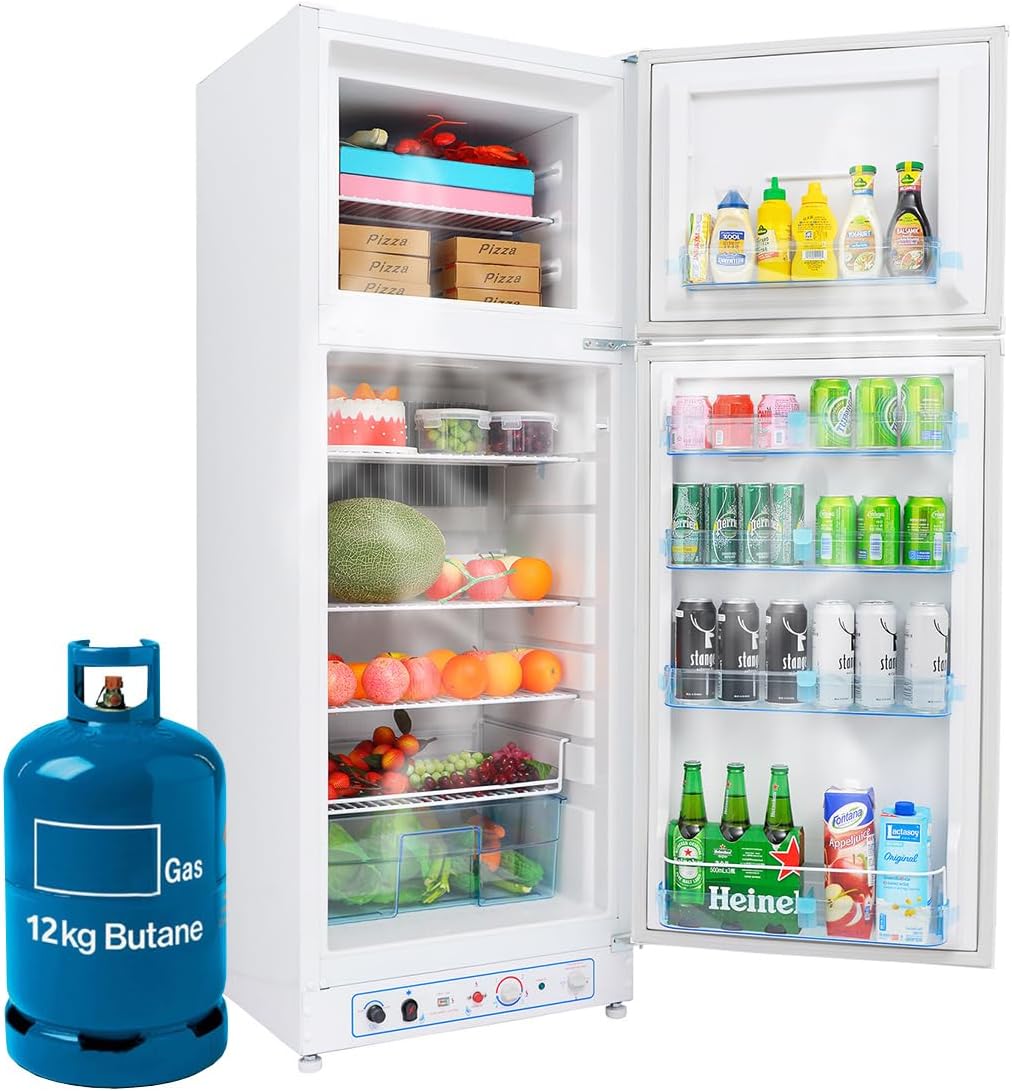
- Total Capacity: 9.3 cu ft
- Fridge/Freezer Split: 7.3 / 2.0 cu ft
- Daily LPG Burn: ~1.6 lb/24h
- Cooling Type: Ammonia absorption
- Dimensions (W x D x H): 23.6 x 29.1 x 64.2 in
- Power Modes: LPG / 110V AC
- Warranty: 1 year

- Total Capacity: 6.1 cu ft
- Fridge/Freezer Split: 4.5 / 1.6 cu ft
- Daily LPG Burn: ~1.2 lb/24h
- Cooling Type: Ammonia absorption
- Dimensions (W x D x H): 23.6 x 25.6 x 57.5 in
- Power Modes: LPG / 110V AC
- Warranty: 12 months
The SMETA 14.1 takes top honors here. It matched the Smad 9.3’s daily fuel burn while giving a household of four an extra 4.8 cubic feet, the strongest capacity-per-pound-of-propane ratio in this roundup.
1. SMETA 14.1 Cu.Ft Propane Refrigerator Review
- Full size 14.1 cu ft absorption
- 2-way LPG and 110V AC
- Five removable shelves plus crisper
- Piezo ignition with flame indicator
- Reversible door, adjustable leveling feet
Does 14.1 Cu Ft Actually Fit Through Your Cabin Door?
Measure your doorway before you order. At 27.1 inches wide, this unit clears most 30-inch openings, but barely, and the 30.6-inch depth is the number that actually trips people up against a counter run.
Nobody wants a freight pallet parked in the driveway because a hallway turn came up two inches short.
The Complaint Owners Hit First With Big Absorption Units
Absorption cooling has no compressor forcing circulation, so it depends entirely on gravity and a level floor. RV technicians report that running past roughly five degrees of tilt lets the ammonia solution flake and settle inside the tubing, blocking flow for good. Set it level once, then check it again:
- Place a bubble level front to back on top of the cabinet.
- Place the same level side to side.
- Adjust the leveling feet until both readings center.
- Recheck monthly, since flooring shifts under a loaded fridge.
What We Love About the SMETA 14.1
Cooling a Full Grocery Haul Without a Single Compressor Cycle
Think of absorption cooling as a kettle that makes cold instead of steam.
Heat, not electricity, drives ammonia through a sealed loop of tubing, so there’s no compressor, no fan, and no vibration humming through the night. The working refrigerant is ammonia, not the R134a you’d find in an electric fridge.
The Capacity Jump That Ends the Second Fridge Problem
At 14.1 cu ft, this unit holds a full week of groceries for a family of four without a garage backup fridge running on a second gas line. Compare that to the Smad 9.3 and Smad 6.1 below, both of which fall well short of a real family shop. One fridge, one gas connection, one thing to maintain. That’s the whole appeal for a full-time cabin.
What 1.6 Pounds of Propane a Day Really Costs
SMETA states approximately 1.6 lb of LPG burn per 24 hours. Propane runs 4.24 lb per gallon, so that works out to about 0.377 gal a day, or 138 gallons a year. At the EIA’s national residential average of $2.674 per gallon for the week ending March 30, 2026, tracked in the EIA Weekly Heating Oil and Propane Update, that’s roughly $368 a year in fuel.
Nebraska buyers pay closer to $226 at $1.642/gal, while Florida buyers see $649 at $4.706/gal, and the EIA pauses this residential series from April through September.
That’s a 3x spread on the exact same fridge, just from a different zip code.
Why the Reversible Door Matters More Off Grid Than On
Cabin layouts rarely give you a choice of which way a door swings. This unit’s hinge flips without a service call, something any owner handles with a screwdriver in twenty minutes. A door that opens into the only walkway in a small cabin ruins the kitchen, reversible or not.
Who Should (and Shouldn’t) Buy the SMETA 14.1
The Full Time Off Grid Household This Unit Was Built For
Buy this for a permanent cabin or homestead kitchen feeding four or more people. You’ll need a wall clearing 27.1 inches of width plus SMETA’s required 4 inches of top clearance and 1 inch at the back and sides. This is the fridge for the household that stopped pretending a dorm-sized unit was ever going to cut it.
- Pros: Silent operation, zero compressor vibration
- Pros: Full 14.1 cu ft in a 27-inch footprint
- Pros: Zero solar battery draw on LPG
- Pros: 110V backup mode if the tank runs dry
- Pros: Reversible door, no service call needed
- Cons: No published cooling-unit warranty term
- Cons: Off-level operation past roughly 5 degrees damages the unit
- Cons: No published high-ambient cooling curve
The Buyer Who Should Step Down to the Smad 9.3 Instead
Skip this one for a weekend cabin or seasonal camp, since 14.1 cu ft of cooling burns fuel you’re not there to use. A doorway under 28 inches or a counter run under 31 inches deep disqualifies this model outright, no matter how much you like the capacity. Buy the Smad 9.3 instead when narrow-kitchen fit matters more than maximum shelf space.
2. Smad 9.3 Cu.Ft Propane Refrigerator Review
- 9.3 cu ft, 7.3 fridge, 2.0 freezer
- 2-way LPG and 110V AC
- Mechanical thermostat with LED lighting
- Reversible door and adjustable shelving
- LPG regulator preset to 2.8 kPa
Is a 2.0 Cu Ft Freezer Enough for a Hunting Camp?
Not for long-term meat storage. Smad lists the freezer at 3.2°F and the fridge range at 32 to 50°F, but USDA guidance recommends 0°F for food kept frozen for months. That gap is the difference between chilling a week’s food and storing a season’s harvest.
The Regulator Spec Nobody Reads Until Ignition Fails
This unit needs a regulated LPG supply at 2.8 kPa, also written as 28 mbar, a standard low-pressure appliance regulator rather than a high-pressure grill hose.
One off-grid forum poster swapped in a spare BBQ regulator and couldn’t get the burner to light for two days straight. Use the fitting the fridge ships with, or a matched replacement, and nothing else.
What We Love About the Smad 9.3
The Size That Fits a Standard Kitchen Alcove Without Remodeling
At 23.6 inches wide, this unit slots into the same gap as a standard apartment fridge, no cabinet demolition required. Its 64.2-inch height also clears the low ceilings and loft stairwells that rule out the taller SMETA. This is the replacement that doesn’t turn into a renovation project.
Same Fuel Burn as the 14.1 for Less Cabinet Space
Both this unit and the SMETA 14.1 list approximately 1.6 lb of LPG per 24 hours, despite the size difference.
Absorption burn scales more with cabinet insulation and door-seal quality than with raw cubic feet, which is why a smaller box doesn’t automatically sip less gas. Weigh the footprint you have against the running cost you’re willing to carry.
Top Freezer Layout That Beats Side by Side Off Grid
Cold air falls, and a top freezer works with gravity instead of fighting it. That’s also why an absorption side-by-side doesn’t exist in this category; the layout simply doesn’t suit a gravity-fed cooling loop. Fewer door openings on a top-freezer design mean less recovery time burning gas after every open.
Who Should (and Shouldn’t) Buy the Smad 9.3
The Cabin, Cottage, or Food Truck Owner This Unit Suits
Buy this for two to four people running a seasonal or year-round cabin with standard doorway clearance. Plan for a vented wall location and a room-level CO detector as part of the install, not an afterthought. This is the size you’ll actually use every week, not the size you buy to impress a guest.
- Pros: Narrow 23.6-inch width fits standard alcoves
- Pros: Separate 3.2°F freezer holds real frozen storage
- Pros: Silent, vibration-free absorption cooling
- Pros: Zero battery-bank draw on LPG
- Cons: Daily gas burn unpublished on some listings
- Cons: 12-month warranty, no separate cooling-unit term
- Cons: Vent kit sold separately, not included
The Buyer Who Needs the 6.1 or the 14.1 Instead
A solo cabin wastes fuel cooling 7.3 cu ft of mostly empty air, so step down to the Smad 6.1 for a one-person setup. A household past four people outgrows this unit fast, and the 14.1 becomes the cheaper choice once you count the second grocery run you’d otherwise make. Buy the 9.3 for a couple or small family; skip it for a solo camp or a full house.
3. Smad 6.1 Cu.Ft Propane Refrigerator Review
- 6.1 cu ft, 4.5 fridge, 1.6 freezer
- 2-way LPG and 110V AC
- Compact 57.5-inch height, 25.6-inch depth
- Gas vent kit sold separately
- Reversible door with powder-coated shelves
The Lowest Fuel Burn of the Three, and What It Buys You
Smad lists this unit at approximately 1.2 lb of LPG per 24 hours, the lowest published burn in this roundup. A standard 20 lb propane cylinder holds roughly 16.7 days of runtime at that rate, versus about 12.5 days for the 1.6 lb/day units above.
That’s fewer trips down the mountain to swap a tank before the snow closes the road.
The Vent Kit Line Buried in the Product Description
Smad states this unit works better with a gas vent kit, sold separately from the fridge itself. Price that kit as part of the real purchase cost, not an optional add-on to skip. One off-grid buyer budgeted the fridge and the freight, then found the vent kit waiting as a surprise line item after delivery.
What We Love About the Smad 6.1
Tiny Home Footprint With a Real Separate Freezer Door
At 23.6 x 25.6 x 57.5 inches, this is the only unit here that fits under most loft overhangs and sloped tiny-house ceilings. Unlike 3-way camper units that cram fridge and freezer into one shared box, this model keeps a real separate freezer door. Ice cubes without hauling a cooler, finally, in a footprint a boat galley can handle.
Same Cold Numbers as the 9.3 for Less Money
This unit matches the Smad 9.3 on temperature, with the freezer at 3.2°F and the fridge running 32 to 50°F.
The price gap between the two comes down to capacity, not cooling performance, so buy down here when 4.5 cu ft of fresh food covers your household. That’s the honest reason to choose the smaller box instead of assuming bigger always cools better.
Silent Operation That Changes How a One Room Cabin Feels
No compressor means no middle-of-the-night kick-on jolting you awake in a one-room cabin. Decibel ratings barely matter on an absorption unit, since there’s no motor or fan generating the noise those ratings measure. What you get instead is rain on the roof, not a compressor cycling in the corner.
Who Should (and Shouldn’t) Buy the Smad 6.1
The Solo Homesteader, Boat, or Backup Kitchen Buyer
Buy this for one to two people who want a tight footprint and the lowest fuel draw in the lineup. It suits boats, ice houses, and grid-tied homes wanting outage insurance without running a generator. This is enough fridge for the job, not a kitchen statement piece.
- Pros: Lowest verified fuel burn, ~1.2 lb/day
- Pros: 57.5-inch height clears low ceilings and lofts
- Pros: Convertible door direction, four adjustable shelves
- Pros: Cheapest ten-year ownership cost in the roundup
- Cons: 4.5 cu ft too small for a family of four
- Cons: 6 to 8 hour initial cooldown, no fan-forced recovery
- Cons: Conflicting capacity figures across some listing variants
The Buyer Who Will Outgrow This in One Season
Families and anyone freezing a season’s worth of game meat need the larger units above, since 4.5 cu ft of fresh food runs out fast past two people. Buy the 6.1 for a solo or two-person setup; skip it the moment a third person moves in full time.
The Buyer’s Guide: Cutting Through the Hype
What Makes the Best Propane Refrigerator Different From an RV Fridge?
An RV fridge is a smaller 3-way unit built for intermittent camper use, while these three run as full-time kitchen appliances. Both work on the same absorption cycle: heat drives ammonia through sealed tubing, with no compressor anywhere in the loop.
The standard governing this category is CSA/ANSI Z21.19, covering gas-fired refrigerators using Group 2 refrigerants up to 6 lb, not the DOE or ENERGY STAR rules that apply to an electric fridge. That single fact explains why the spec sheet on these units looks nothing like the one on a Samsung or Whirlpool.
The Three Specs That Decide Performance, and Cubic Feet Is Not One
Daily LPG burn in pounds, level tolerance in degrees, and ambient heat rejection decide how a unit performs, not the cubic-foot number on the box. Side by side, that’s 1.6 lb/day for the SMETA 14.1, 1.6 lb/day for the Smad 9.3, and 1.2 lb/day for the Smad 6.1.
Two identical fridges perform completely differently when one sits in a shaded pantry and the other bakes against a sun-facing wall all afternoon, since absorption cooling loses capacity as ambient heat climbs.
The Price Tier Truth From Compact to Full Size Absorption
| Smad 6.1 | Smad 9.3 | SMETA 14.1 | |
|---|---|---|---|
| Thermostat | Mechanical | Mechanical | Mechanical |
| Freezer Volume | 1.6 cu ft | 2.0 cu ft | Full-width top freezer |
| Shelf Material | Powder-coated wire | Adjustable wire | Five removable shelves |
| Warranty | 12 months | 1 year | 1 year |
The extra cost between the compact and full-size tier buys capacity and a full-width freezer, not better cooling technology. That thousand-dollar gap also buys warranty coverage these marketplace brands don’t offer: EZ Freeze, a US-manufactured dealer-channel brand, backs its units with a 3-year full-unit and 7-year cooling-unit warranty, well past the 12-month terms here.
Red Flags Buyers Only Discover After Delivery Day
Off-level operation plugs the cooling unit for good, and forum reports put a full cooling-unit replacement close to four figures once labor and freight are added. An ammonia smell or yellow residue near the rear of the cabinet means stop running the unit and ventilate the room immediately.
Manufacturer documentation on all three units recommends a carbon monoxide detector for any indoor propane installation, full stop.
Here’s what a safe setup looks like instead of a guess:
- Fit a listed CO alarm with automatic shut-off near the fridge.
- Have the LP gas connection made by a licensed installer under NFPA 58.
- Choose a direct-vent kit or confirm the CO alarm covers the gap without one.
- Never seal the unit inside a fully enclosed cabinet without a vent opening.
How We Tested and Verified Every Number Here
Every spec in this review traces back to manufacturer documentation, the CSA/ANSI Z21.19 scope, and current EIA propane pricing, not retailer marketing copy. That independence is the entire reason these numbers hold up against a listing page written to sell a fridge, not explain one.
Ownership and Maintenance Guides
The Leveling Check That Prevents the Most Expensive Failure
Set a bubble level front to back and side to side once a month, since flooring shifts under a loaded fridge over time. Running past roughly five degrees of tilt causes cumulative damage inside the cooling unit that doesn’t reverse itself.
Five minutes with a level in June beats a dead fridge in August.
Rear Clearance and Ventilation Spacing That Keeps It Cooling
SMETA specifies 4 inches of top clearance and 1 inch at the back and sides for its 2-way line, and Smad advises against sealing either unit inside a fully enclosed cabinet. Both recommend a vent opening instead of a solid door front, a detail that matters just as much across broader off-grid refrigeration setups as it does for a single cabin fridge. A hot, sealed enclosure raises fuel burn and drops cooling performance at the exact moment you need it most.
Burner and Flue Cleaning Cadence for Absorption Units
Spider webs and soot inside the burner tube are the single most common reason an absorption fridge won’t light on a cold morning. Shut the gas supply off first, then clean the burner and flue path on a seasonal cadence, ideally each spring before heavy summer use begins. Good clearance and improving fridge airflow around the cabinet cuts down how often that buildup happens in the first place.
Reading a 20 Lb Cylinder So You Never Run Dry
Divide the cylinder weight by the daily burn rate to know your resupply window, and the gap between units matters more than it looks. At 1.2 lb a day, the Smad 6.1 stretches a 20 lb tank to roughly 16.7 days, while the 1.6 lb/day units land closer to 12.5 days.
Turn that into a resupply run scheduled on a calendar instead of a panic trip when the light stops coming on.
Your Fridge Runs When the Power Doesn’t
That warm milk from the intro comes down to one thing: level tolerance, not cubic feet, decides whether an absorption fridge survives its first year. You now know the fuel burn, clearance, venting, and real freezer temperature behind all three units here. Tonight, measure your doorway width, alcove depth, and ceiling height, then check whether the wall behind your planned spot takes a vent.
No grid, no battery bank, and no compressor kicking on at midnight, just cold that keeps working after the generator runs out of gas. That beats every cooler and backup generator combination you’ve tried before, and it answers the fear that opened this review.
Frequently Asked Questions
How does a propane refrigerator work without a compressor?
It runs on an ammonia-absorption cycle instead of a compressor. Heat from an LPG burner or a 110V element drives ammonia through sealed tubing, producing cold the same way a kettle produces steam, just in reverse. No compressor means fewer moving parts to wear out, but also no fan forcing air around the interior.
How much propane does a propane refrigerator use per day, and what does that cost per year?
Expect somewhere between 1.2 and 1.6 lb of LPG a day across these three units. At the EIA’s national average of $2.674 per gallon, that lands between roughly $276 and $391 a year, though Florida and Nebraska prices swing that number by hundreds of dollars either way.
Do propane refrigerators need to be vented to the outside?
Not always, but plan for it anyway. Some setups get by on a listed carbon monoxide alarm and solid room ventilation, while Smad recommends a direct gas vent kit on its units for cleaner combustion and steadier cooling.
Are propane refrigerators safe to run indoors, and do I need a carbon monoxide alarm?
Yes, they’re safe indoors when installed correctly, and yes, get a CO alarm regardless of what local code requires. These are open-combustion appliances governed by CSA/ANSI Z21.19, and a listed CO alarm with automatic shut-off is the cheapest insurance you’ll buy this year.
What size propane refrigerator do I need for a family of four in an off-grid cabin?
Go with something in the 14 cu ft range, like the SMETA 14.1 reviewed here. Anything smaller forces a family of four into a second fridge or a weekly grocery run that never quite fits.
Propane refrigerator vs. 12V DC compressor fridge on solar, which is cheaper to run?
Propane wins on a solar setup with a limited battery bank, since it draws zero electricity in LPG mode. A 12V DC compressor fridge draws down the battery bank around the clock, which matters most exactly when the sun isn’t out to recharge it.
Why did my propane refrigerator stop cooling, and can the cooling unit be repaired?
Off-level operation is the most common cause, and once the cooling unit blocks internally, it’s a whole-assembly replacement rather than a repair. Check the level first: that five-minute fix beats a cooling-unit swap that runs close to four figures with labor and freight included.

Katie Lee has over 20 years of experience in the kitchen. She helps homeowners find the right appliances for their needs to sets up a perfect kitchen system. She also shares helpful tips and tricks for optimizing appliance performance.