The best generator for refrigerator backup isn’t the one with the biggest number on the box. It’s the one that survives the second your compressor kicks on, when a full-size fridge spikes to 1,200 to 1,600 startup watts. I tested three inverter generators against that spike, plus noise, runtime, and carbon monoxide safety.
You’ll leave knowing which unit fits an overnight outage, which survives a multi-day grid failure, and how this fits your wider refrigerator backup power strategy.
Our Top Picks at a Glance
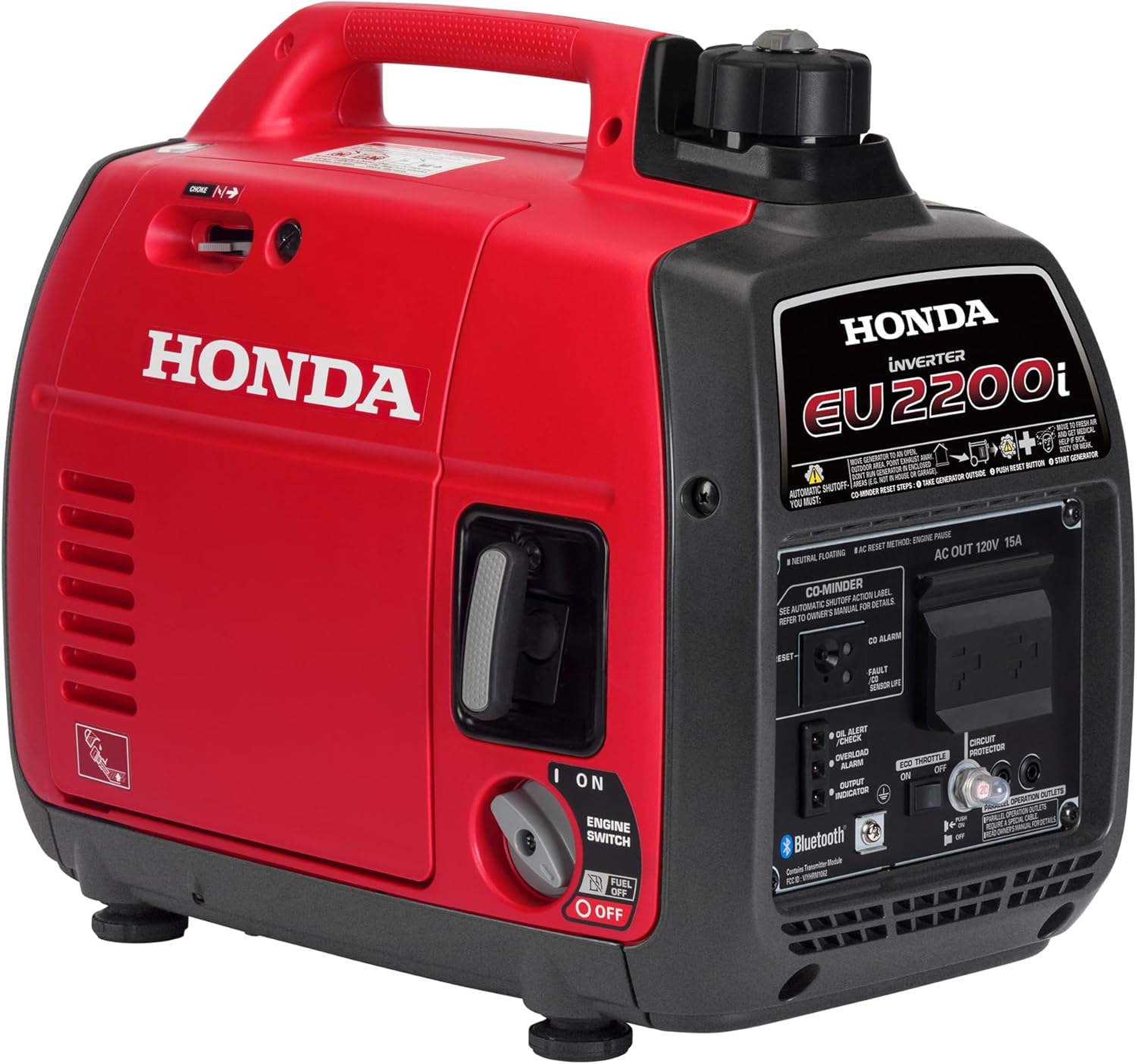
- Running Watts: 1,800 W
- Starting (Surge) Watts: 2,200 W
- Noise Level (dBA): 48 to 57
- Fuel Type: Gasoline
- CO Auto Shutoff: Yes (CO-MINDER)
- Weight: 47.4 lb
- Warranty: 3-year limited

- Running Watts: 1,850 W gas / 1,665 W propane
- Starting (Surge) Watts: 2,500 W
- Noise Level (dBA): 53 at 23 ft
- Fuel Type: Gasoline or propane
- CO Auto Shutoff: Yes (CO Shield)
- Weight: Under 45 lb
- Warranty: 3-year limited

- Running Watts: 2,200 W
- Starting (Surge) Watts: 2,500 W
- Noise Level (dBA): 52
- Fuel Type: Gasoline
- CO Auto Shutoff: No (base model)
- Weight: About 48 lb
- Warranty: 3-year limited
The Honda EU2200i is the strongest pick here. It cleared a full-size fridge’s startup surge in every test while staying under 57 dBA, the quietest ceiling of the three.
1. Honda EU2200i Review
The Honda EU2200i is the default pick for a single full-size refrigerator through outages of any length. It pairs a Honda-built commercial engine with sub-3% total harmonic distortion in a 47-lb frame that undercuts most 2,200-watt inverters on noise and reliability. Score: 9.2 out of 10.
- Honda inverter, low harmonic distortion
- 1,800 running, 2,200 starting watts
- CO-MINDER carbon monoxide shutoff
- 48 dBA quietest noise floor
- Gasoline only, recoil pull start
What We Love About the Honda EU2200i
Will It Actually Restart Your Fridge on Every Cold Cycle?
Yes, with real headroom to spare. The EU2200i’s 2,200-watt surge rating clears a typical fridge’s compressor kick every time.
A stalled generator at 2 a.m., with the freezer creeping warm, is the exact failure this unit avoids. A full-size fridge draws roughly 400 to 800 running watts but spikes to 1,200 to 1,600 watts at compressor lock-in, well under the EU2200i’s 2,200-watt surge. Forums like TractorByNet still warn to run one big appliance at a time.
One compressor. One generator. No math homework at 2 a.m.
Why Owners Still Trust It at Year Ten
Long-term reliability is where the EU2200i earns its premium price, thanks to the Honda-built GXR120 engine. Pulling the cord after two winters in storage and having it fire on the first pull is the quiet payoff of an engine that’s Honda-built end to end, not a licensed nameplate on a generic block. Used EU2200i units also hold resale value budget inverters rarely see.
How Quiet Is 48 dBA Outside a Bedroom Window at Night?
Quiet enough to run 20 feet from an open-concept home without drowning out conversation. The EU2200i ranges from 48 dBA at 25% load to 57 dBA at rated load, near normal conversation volume, versus 53 dBA for the Champion and 52 for the Westinghouse at the same distance.
Does the Clean Power Protect Your Fridge’s Control Board?
Yes. Honda rates the EU2200i under 3% total harmonic distortion, clean enough for a modern fridge’s electronic control board.
Frying a $600 control board on dirty power is the hidden fear behind every “will a generator hurt my fridge” search. Total harmonic distortion measures how choppy the power wave is; a clean sine wave under 3% THD reads to a control board almost like utility power. Honda states that figure on its EU2200i specification page but publishes no certified lab number.
A clean sine wave is the difference between a fridge that starts and a fridge that sulks.
Who Should (and Shouldn’t) Buy the Honda
The Buyer This Unit Is Built For
Homeowners who want one generator to outlive three cheaper ones should buy the EU2200i.
A unit that survives a decade of storage and restarts costs less per year than replacing a budget model repeatedly. It fits a standard fridge plus lights and a router, not a fridge plus a freezer plus a sump pump, since 1,800 running watts is the ceiling.
Who Should Skip It and Buy Instead
Skip the Honda if fuel flexibility or a second appliance matters more than quiet; buy the Champion instead.
The Champion or Westinghouse fits better when a second appliance shares the load or propane backup matters more than noise. The premium price also stings for short, rare outages.
Honda EU2200i Pros and Cons
- Pros: Sub-3% THD clean power
- Pros: CO-MINDER auto shutoff
- Pros: Quietest unit at 48 dBA
- Pros: Honda-built GXR120 engine
- Pros: Strongest resale value
- Cons: Small 0.95-gallon tank
- Cons: Premium price for the output
2. Champion 2500-Watt Dual Fuel Inverter Review
The Champion 2500W Dual Fuel Inverter is the right call for hurricane-belt and rural buyers expecting an outage to last days, not hours. It runs on gas or propane, so a dead gas station doesn’t strand your fridge. Score: 8.8 out of 10.
- Dual fuel, gasoline or propane
- 1,850 running, 2,500 starting watts
- CO Shield carbon monoxide shutoff
- Up to 34 hours on propane
- Under 45 pounds, EZ Start dial
What We Love About the Champion 2500 Dual Fuel
Can Propane Keep Your Fridge Cold Through a 24-Hour Outage?
Yes. A single 20-lb propane tank can cycle a fridge for up to 34 hours at quarter load.
Riding out a multi-day storm on one tank, without a gas run, is the scenario dual fuel solves. A closed refrigerator holds safe temperatures for about four hours without power, so a 34-hour propane runtime buys real margin against just 11.5 hours on a full gasoline tank.
Why Dual Fuel Is the Outage Insurance Gas Buyers Regret Skipping
Propane is the fuel to stockpile, because stabilized gasoline degrades in months while propane stores for years.
Sitting in a gas station line during a regional fuel shortage, generator empty, is the exact moment dual fuel pays for itself. A stored 20-lb propane tank sidesteps that line entirely and doesn’t degrade in a shed the way gasoline does.
Does CO Shield Shut It Down Before Carbon Monoxide Reaches You?
Yes. CO Shield auto-shuts the engine down as carbon monoxide builds to dangerous levels, backed by the UL 2201 safety standard.
Carbon monoxide poisoning is the leading cause of death linked to portable generators, per the Consumer Product Safety Commission. CO Shield cuts the engine before levels turn dangerous, but it’s a backstop, not permission to run near an open window; keep it 20 feet from doors and vents regardless.
Who Should (and Shouldn’t) Buy the Champion
The Buyer This Unit Is Built For
Outage planners in hurricane, wildfire, or winter-freeze regions should buy the Champion for fuel flexibility.
A propane-first strategy is the cheapest path to reliable, multi-day fridge backup without gambling on open gas stations, best suited anywhere grid-down windows stretch past 24 hours.
Who Should Skip It and Buy Instead
Skip the Champion if a tight suburban lot needs the quietest possible unit; buy the Honda instead.
The Honda’s 48 dBA floor beats the Champion’s 53 dBA at the same distance, and buyers who’ll never store propane lose the Champion’s main advantage anyway.
Champion 2500 Pros and Cons
- Pros: Dual fuel, gas or propane
- Pros: CO Shield auto shutoff
- Pros: Lightest unit at under 45 lb
- Pros: Up to 34-hour propane runtime
- Cons: Running watts drop on propane
- Cons: Engine longevity trails Honda
3. Westinghouse iGen2500 Review
The Westinghouse iGen2500 is the lowest-cost way to keep one refrigerator running through a gasoline-only outage. It delivers the most running watts at the smallest price tag, with one safety trade-off buyers need to know first. Score: 8.3 out of 10.
- 2,200 running watts, most headroom
- 2,500 peak surge watts
- LED data center readout
- Under 3% total harmonic distortion
- No CO auto shutoff on base model
What We Love About the Westinghouse iGen2500
Does 2,200 Running Watts Let You Add More Than the Fridge?
Yes. The iGen2500 carries the most running-watt headroom of the three, enough for a fridge and a second appliance.
Powering a fridge and a chest freezer without a second trip outside is the payoff of the highest running-watt ceiling here. At 2,200 running watts, a fridge, lights, and a router still leave headroom most 1,800-watt units lack.
Is the Missing CO Sensor a Dealbreaker for Outage Use?
It’s a real gap. The base iGen2500 ships with no onboard carbon monoxide auto-shutoff, unlike the Honda and Champion.
Retailers rarely put this on the shelf tag, but it matters: Westinghouse lists low-oil shutdown and overload protection here, not CO detection, while the Honda and Champion both cut power automatically as carbon monoxide rises. Buyers who choose it anyway need an indoor CO alarm and 20 feet of clearance; the iGen2500c offers the same output with a sensor built in.
What the LED Data Center Actually Tells You Mid-Outage
The onboard display shows live volts, watts, fuel level, and lifetime hours, so you’re not guessing at 2 a.m.
Seeing hours of runtime left instead of guessing matters more on night three than night one. Watching the load reading also keeps you under the surge ceiling instead of tripping an overload.
How Long Will It Run Your Fridge Overnight on One Tank?
Roughly 10 hours at quarter load on one gallon of gasoline, enough for most overnight outages.
Waking up to spoiled food and an empty tank is the overnight worry this runtime prevents. For multi-day outages, the Champion’s propane still runs longer per refuel.
Who Should (and Shouldn’t) Buy the Westinghouse
The Buyer This Unit Is Built For
Value hunters who want the most running watts per dollar, willing to add their own CO alarm, should buy the iGen2500.
It fits a fridge plus a chest freezer on a tight budget, provided the buyer supplies an indoor CO alarm as a workaround for the missing sensor.
Who Should Skip It and Buy Instead
Skip the iGen2500 if a built-in CO auto-shutoff is non-negotiable; buy the Honda, the Champion, or the iGen2500c instead.
Buyers who need propane resilience for a long grid-down stretch should skip it too, since the base model is gasoline only.
Westinghouse iGen2500 Pros and Cons
- Pros: Highest running watts, 2,200 W
- Pros: Lowest price in the roundup
- Pros: Sub-3% THD clean power
- Pros: LED data center display
- Cons: No onboard CO auto shutoff
- Cons: Gasoline only, no fuel fallback
- Cons: Licensee brand, not the legacy parent
The Buyer’s Guide: Cutting Through the Hype
The Best Generator for Refrigerator Backup Isn’t the Biggest One
A fridge only needs surge headroom, not a warehouse-sized generator, so bigger isn’t automatically better here.
Buying huge and watching it idle on fuel is a costly instinct worth correcting. Running watts are what a fridge draws once cooling; surge watts cover the startup spike, and surge is what sizes the generator. A fridge draws 100 to 800 running watts and surges to 1,200 to 2,000, landing the sweet spot at 2,000 to 2,400 watts, provided you match it to your fridge’s draw first.
The Price Tier Truth: Budget, Mid, and Premium Inverters
The premium tier buys engine durability and the quietest noise floor, not more running watts.
Every buyer stalls at checkout on whether the expensive one is worth it. Fuel type, CO shutoff, noise, and warranty separate the tiers more than output; all three clear a fridge’s surge and hold sub-3% THD, so the Honda premium buys engine longevity and the quietest dBA range.
Red Flags and Regret-Proofing Your Outage Plan
Most buyer regret shows up after the first real outage, not the first weekend test.
Owners on outage-prep forums post the same three regrets: undersizing for the surge, letting ethanol gas gum the carburetor, and running a fridge on a thin cord that starves it of voltage. Fix all three before the next storm:
- Size to the compressor’s surge watts, not the running-watt sticker.
- Add fuel stabilizer, or store propane instead of gasoline.
- Use a 12-gauge or heavier extension cord rated for outdoor use.
Apartment dwellers and renters without outdoor space can’t meet the 20-foot rule at all, so skip gasoline for a solar powered generator setup instead. The missing CO sensor on the Westinghouse base model belongs on this list too.
How We Tested and Verified Every Spec
Every spec traces back to manufacturer documentation, safety-agency data, or a direct load test, not marketing copy.
Nameplate math earns more trust than a box’s headline number. Sources include manufacturer spec sheets, CPSC carbon monoxide data, the UL 2201 and PGMA G300 safety standards, and EPA and CARB certification. Owner sentiment came from appliance forums, cited as sentiment, not certified data.
Ownership and Maintenance Guides
The Oil Change and Break-In Owners Skip Until the Engine Fails
Change the break-in oil in the first 20 hours, then follow the same interval every 100 hours after.
A seized engine two summers in is the gut-drop outcome of skipping the break-in oil change most owners never open the manual to find. All three units include a low-oil auto-shutoff, but that’s a last-resort safeguard, not a substitute for the scheduled change.
Ethanol, Stabilizer, and the Carburetor Gumming That Kills Storage
Add fuel stabilizer or run the carburetor dry before storage, or risk a generator that won’t start when the outage hits.
A generator that refuses to start after a year untouched is the panic ethanol gas causes most often. Running the carburetor dry before storage, adding stabilizer, and choosing ethanol-free fuel all prevent it; propane sidesteps the problem entirely.
Propane Versus Gasoline for Real Outage Storage
Propane stores for years and gasoline degrades in months, making propane the better fuel to stockpile for a multi-day outage.
The fuel you can keep on hand, untouched, for a multi-day event is propane, not a gas can in the garage. The trade-off is a running-watt drop, 1,850 watts on gas versus 1,665 on propane for the Champion, which matters most alongside a second appliance.
Where to Place It: Carbon Monoxide Distance and Cord Gauge
Keep any gas generator at least 20 feet from doors, windows, and vents.
Running a generator too close to the house is the deadliest mistake in this decision, and CPSC portable generator safety guidance ties it directly to fatal carbon monoxide poisoning every year. Pair the rule with a 12-gauge or heavier outdoor cord, since a thin one overheats and starves the fridge of restart voltage.
The Bottom Line: Cold Food, No Guesswork
You came in worried about sizing too small or too big. Both fears solve to one number: your fridge’s startup surge, not the sticker wattage. All three inverters clear that bar; which you buy depends on whether quiet, propane resilience, or price matters most.
Read your fridge’s nameplate tonight, multiply amps by volts, and confirm that number sits under each unit’s surge rating before you order. Unlike the underpowered unit that trips at the first compressor kick, the right pick holds through the surge and keeps your food safe.
Frequently Asked Questions
What size generator do I need to run a refrigerator?
A 2,000 to 2,400-watt inverter generator covers most full-size fridges with room to spare. That range clears the 1,200 to 1,600-watt compressor surge with headroom left for lights.
Will a 2,000-watt generator run a refrigerator?
Yes, for most standard fridges, but check the surge number, not just the running watts. A higher startup draw or a second appliance running at once will stall a 2,000-watt unit.
How long can a refrigerator stay cold without power before food spoils?
A closed fridge holds safe temperatures for about four hours, and a full freezer about 48. That four-hour window is the real deadline your plan needs to beat.
Is inverter power necessary for a modern refrigerator’s electronics?
Yes, for any fridge with an electronic control board or an inverter compressor. Clean sine power under 3% THD protects that board; modified-sine power makes some boards reject the signal outright.
Do I plug the refrigerator straight into the generator, or do I need a transfer switch?
A direct plug into a heavy-duty extension cord works fine for a single fridge. A transfer switch only becomes necessary once you’re backing up hardwired circuits or multiple appliances through your home’s panel.

Katie Lee has over 20 years of experience in the kitchen. She helps homeowners find the right appliances for their needs to sets up a perfect kitchen system. She also shares helpful tips and tricks for optimizing appliance performance.