You bought a fridge for the truck, van, or road trip. Now a car inverter for refrigerator use has you staring at a wattage sticker, wondering if it’ll run the thing or leave you with warm food and a dead battery. That “1000W” number feels like permission, but it skips the startup surge that stalls a compressor cold.
Finish this, and you’ll size the inverter right, spot the waveform that quietly cooks compressors, and know when skipping the inverter beats buying one. For the full picture on backup power, see everything on refrigerator power backup.
Car Inverter for Refrigerator
A car inverter for refrigerator use converts 12-volt DC battery power into 120-volt AC. It must survive running watts plus a much bigger compressor startup surge. Size it to the surge, not the box, and pick pure sine wave output. Van lifers, RVers, and campers need this most.So can this inverter actually run my fridge?
Yes, a car inverter runs a refrigerator, sized past the compressor’s startup surge and outputting pure sine wave power. Get either wrong and the fridge won’t start, or won’t survive the trip.
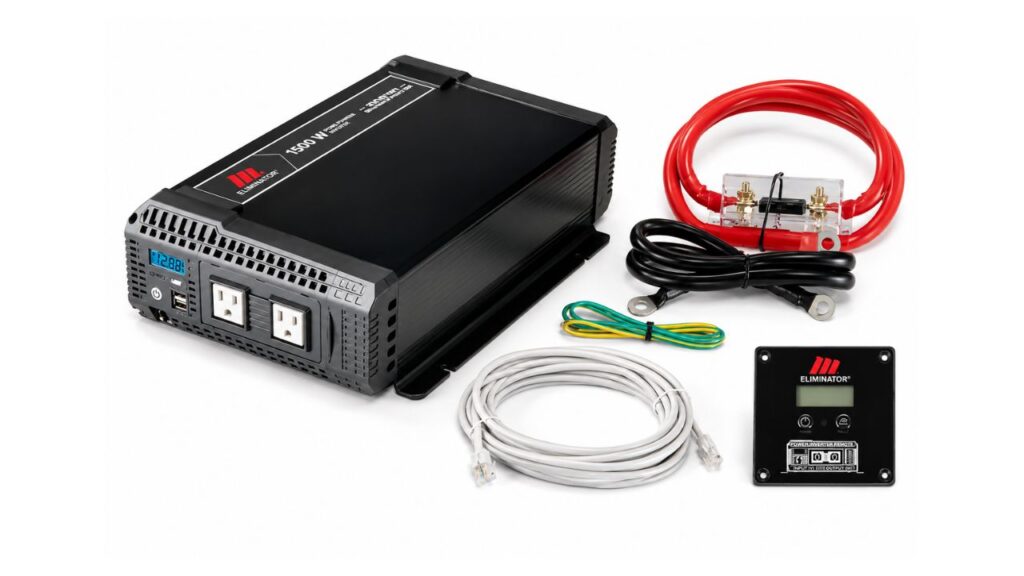
What a car inverter for refrigerator setups really does
A car inverter takes 12-volt DC battery power and flips it into 120-volt AC, the power a wall outlet delivers. Vehicle inverters span roughly 100W to 3000W. A wall-plug fridge can’t sip DC straight from the battery, its motor needs AC.
Portable compressor fridge vs. the mini fridge from your dorm
A 12V compressor fridge and an AC mini fridge draw current very differently, deciding what inverter you need.
| Fridge type | Running watts | Startup surge |
|---|---|---|
| 12V compressor fridge (portable style) | 30 to 60W | Minimal, soft-start motor |
| AC mini fridge (dorm/office style) | 70 to 100W | Spikes 2 to 3x on startup |
Find your fridge’s nameplate watts before buying anything, stamped inside the door or on the compressor housing.
The question underneath the question: will it strand me?
The real fear isn’t the inverter, it’s a dead battery or a fried compressor two hundred miles from home. Two risks: battery drain and compressor damage, both avoidable once you know your fridge’s actual numbers instead of the box’s marketing wattage.
So where do those numbers actually come from?
Running watts lie. Startup surge tells the truth.
Running watts tell you what the fridge needs once going, not what it needs to start. Startup surge decides whether the inverter can turn the compressor on at all.
Why your compressor gulps before it sips
A compressor motor draws a brief power spike the instant it kicks on, overcoming inertia before it spins freely. That inrush commonly runs 2 to 3 times running watts, a fridge pulling 150 running watts can spike past 400 watts briefly. That surge, not the running number, sets your true minimum inverter size.
The nameplate numbers most buyers skip
Locked rotor amps (LRA), the startup current on many fridge and compressor nameplates, is the number most buyers never check. An RV-style compressor fridge might list 1 amp running but 8 to 9 amps at startup. Convert amps to watts (amps times 120) to size against your inverter’s surge rating.
Older compressors and hot garages push that surge higher. Confirm it against the spec sheet or a plug-in meter like a Kill A Watt, sold by P3 International, a privately held energy-monitor maker since 1987. See a full breakdown of amperage for refrigerator figures by type.
The 1.5x rule that keeps your fridge starting
Size the inverter’s continuous rating to at least 1.5 times the fridge’s running watts, then stack a real surge buffer on top. Undersizing means a fridge that clicks and tries to start, then trips the inverter each time.
- Find running watts and LRA on the nameplate.
- Convert LRA to surge watts (amps times 120).
- Add running watts, apply a 20 to 30 percent buffer.
- Round up to the nearest inverter size, never down.
People also ask: what size inverter for a refrigerator?
Match the inverter to your fridge category. Mini and portable units need far less headroom than a full-size household fridge.
| Fridge size | Recommended inverter |
|---|---|
| Mini or portable | 300 to 1,000W |
| Standard household | 1,500 to 2,000W surge |
| Large side-by-side | 2,000 to 3,000W surge |
Sizing solved. So why does waveform matter just as much as the number?
Pure sine vs. modified sine: the quiet compressor killer
Pure sine wave power matches the smooth AC your fridge’s compressor was built for. Modified sine wave doesn’t, and that shows up as heat, noise, and a shortened compressor life.
What modified sine wave actually does to a motor
Modified sine wave power is a choppy square wave dressed up to look like AC, and a compressor motor was never built to run on it. Fed that shape, motors run hotter, hum louder, and work harder for the same cooling, and sensitive compressors can fail outright over months.
Why pure sine is the non-negotiable for fridges
Pure sine wave output mirrors the clean 60Hz AC from a home outlet, exactly what a compressor motor expects. Modified sine inverters run 70 to 80 percent efficient overall; pure sine runs above 90 percent, sparing motors the 20 percent penalty modified sine imposes on inductive loads.
Victron Energy, a privately held Dutch manufacturer of solar and power electronics founded in 1975, shows that clean output curve in its pure sine wave inverter specifications. One limitation: pure sine costs noticeably more than modified sine at the same wattage.
The cheap inverter that hums, buzzes, and fails
Budget modified-sine inverters, like entries from BESTEK, a self-owned brand under BESTEK Global, are the ones owners report running hot and buzzing under fridge loads. One RV forum owner described a modified-sine setup running a compressor fridge hot enough to notice a faint burnt smell after weeks of daily use, a sign the windings were cooking under the wrong waveform.
Buzzing and unusual heat are early warnings. Confirm the waveform before buying, not after.
Waveform sorted. A good inverter still taxes the battery more than expected.
The double conversion tax no retailer mentions
Running a 12V fridge through an inverter means converting power twice, DC to AC and back to DC, and each conversion bleeds energy nobody bills you for.
Why running a 12V fridge through AC wastes power
Every conversion step loses energy to heat and the inverter’s cooling fan. A 12V fridge run through an inverter pays that tax twice: its power supply steps 120V AC back down to DC internally, on top of the DC to AC step the inverter already did. You pay, in battery drain, for the same cold food twice.
The test that proves the loss is real
A documented head-to-head test found a 12V Vitrifrigo fridge ran about 54 hours off a battery. The same fridge run through an inverter on AC lasted only about 32 hours, roughly a third of the runtime gone just from taking the inverter path.
When the inverter path still makes sense
The inverter is still the right call, when you own an AC-only fridge and replacing it isn’t in the budget. Budget the shorter runtime into your trip planning instead of assuming the fridge runs as long as it did at home.
Runtime sorted. Will any of this kill your car battery?
Will it kill your car battery?
A fridge running off an inverter strands vehicles, when it pulls from the starter battery with the engine off long enough to drop below cranking voltage.
Engine off is where fridges strand people
Your starter battery is built for a short, powerful sprint to crank the engine, not a slow marathon keeping a fridge cold overnight. With the engine off, the fridge pulls straight from that battery, and voltage can dip below cranking level by morning. The alternator only refills it while running.
The idle drain retailers never mention
Even switched on with nothing plugged in, a cheap inverter sips power just from being powered up. One owner logged a 235Ah deep-cycle bank dropping from 12.6V to 11.3V in about 12 hours with no load connected. Flip the inverter off when the fridge doesn’t need AC.
Deep cycle and aux batteries change the math
A deep-cycle battery handles steady fridge draw far better than a starter battery, built for brief high-amp bursts, not hours of drain.
| Battery type | Built for | Fridge duty fit |
|---|---|---|
| Starter/cranking | Short high-amp burst | Poor, drains fast under sustained load |
| Deep cycle (AGM/flooded) | Slow, sustained draw | Good, handles hours of steady pull |
A second auxiliary battery protects your ability to start the car, and a voltage-sensing relay cuts the fridge’s load once the main battery drops too low. Past one overnight stop, off-grid solar power sizing beats stretching a car battery further.
How long can I run a fridge off my car?
Divide usable amp-hours by the fridge’s running amps for a rough runtime. A 100Ah lead-acid battery gives up 50 usable amp-hours at a safe 50 percent depth of discharge, the share of capacity used before recharging.
A low-draw compressor fridge pulling half an amp could run that battery a couple of days, less on an inverter. Peukert’s law explains why real runtime often runs shorter than the simple math: batteries lose effective capacity at higher discharge rates.
Numbers in hand. Now the parts nobody warns you about before wiring it in.
The install gotchas that ambush first timers
Most first-time inverter installs hit the same three snags: an open ground fault, undersized wire, and a cigarette lighter socket that can’t carry the load.
The mysterious open ground error explained
An open ground error means your inverter never bonded its neutral and ground wires like a home outlet does, and many residential fridges check for that bond before running. Inverters built to UL 458, the safety standard for inverters used in land vehicles and marine craft, include an internal neutral-to-ground bonding relay for this reason. Confirm that relay exists before assuming your fridge is broken. See UL’s UL 458 safety standard for what a listed inverter must provide.
Fusing, wire gauge, and the fire you avoid
High DC amperage between battery and inverter demands thick wire and an inline fuse near the battery. Skip either and you’ve built a fire hazard. Mount the inverter close to the battery, shorter runs mean less voltage drop.
Cigarette lighter sockets can’t do this job
Most cigarette lighter sockets cap out around 10 to 15 amps, far below what a fridge inverter pulls at startup. Hardwire any larger inverter straight to the battery posts instead.
How to size and pick yours without guessing
Buying the right inverter comes down to one worked calculation, not the wattage printed on the box.
| Fridge type | Running watts | Surge watts | Minimum inverter |
|---|---|---|---|
| Mini/portable | 100 | 250 | 500W surge |
| Standard household | 600 | 1,400 | 2,500W surge |
| Large side-by-side | 800 | 2,200 | 3,000W+ surge |
Do the surge math in two minutes
Add running watts to the highest surge figure, multiply by 1.2 to 1.3, and round up, never down, the same math from earlier, applied to your actual fridge.
The features worth paying for
Three features separate a fridge-ready inverter from a bargain-bin one: pure sine output, real efficiency, and low idle draw.
| Feature | Why it matters | Skip if |
|---|---|---|
| Pure sine wave | Protects the compressor motor | Never skip for a fridge |
| 85%+ efficiency | Less battery wasted as heat | Rating isn’t published |
| Low idle/parasitic draw | Doesn’t drain the battery when idle | Spec sheet omits idle amps |
Renogy, a privately held inverter and solar equipment maker founded in 2010, publishes idle-draw specs on its datasheets, worth checking since not every maker discloses it. Most budget and mid-tier pure sine inverters treat a genuine low-voltage cutoff as an upgrade, not standard.
Keeping it cold enough to be safe
Food stays safe at 40°F or below, per USDA guidance, regardless of how the fridge gets its power. Bacteria multiply fastest in the 40°F to 140°F danger zone, doubling in as little as 20 minutes. Keep a thermometer inside to verify the real temperature.
Your quick pre buy gut check
Confirm your fridge’s nameplate running watts and startup surge before ordering. Match a pure sine inverter with real margin, then buy.
Sized, wired, and waveform-correct. One more question worth asking before you spend anything.
When the smartest move is skipping the inverter
Sometimes the best inverter for your fridge is no inverter. A 12V compressor fridge plugged straight into your battery sidesteps every problem above.
The 12V DC fridge that sidesteps the whole problem
A 12V compressor fridge, like Dometic’s CFX line, runs straight off your battery’s native voltage: no conversion, no waveform, no idle drain. Dometic, Sweden-based and public on Nasdaq Stockholm since 2015 after EQT’s 2011 buyout, builds these compressors to sip roughly 30 to 60 watts while running.
One limitation: Dometic’s 12V units cost more than a comparable AC mini fridge from Whynter, a privately held California appliance maker founded in 2006, and parts availability on the road can lag a big-box unit.
The honest cost and reliability trade
A 12V fridge costs more to buy but runs far longer per battery charge than an AC fridge paired with an inverter.
| Setup | Upfront cost | Runtime per charge | Notes |
|---|---|---|---|
| 12V DC compressor fridge | Higher | Longest, no conversion loss | Fewer repair shops carry parts |
| AC mini fridge + inverter | Lower combined | Shorter, conversion losses apply | Parts and service widely available |
So who actually needs the inverter?
You need the inverter, when you own an AC fridge you’re not replacing, or run other AC gear off the same source. Sharing one inverter across a laptop charger, an AC unit, and the fridge beats buying a second DC-only system for one appliance.
Conclusion
You walked in trusting a 1000W sticker to be enough. You leave knowing startup surge beats running watts, pure sine protects the compressor, and sometimes the right answer is no inverter at all. Tonight, pull your fridge’s nameplate, write down its running watts and LRA, and run the surge math before anything lands in a cart. A right-sized, clean-power setup keeps food genuinely safe and your car starting in the morning, something a bargain inverter bought on price alone never delivers.
Frequently Asked Questions
Can a car inverter actually run a refrigerator?
Yes, a properly sized pure sine wave inverter runs a fridge without issue. Size it past the startup surge, not just running watts, and confirm the waveform before buying.
What size inverter do I need for a refrigerator?
Match it to your fridge type: 300 to 1,000W for mini or portable, 1,500 to 2,000W surge for standard household, and 2,000 to 3,000W surge for large side-by-side.
Why does a fridge need a pure sine wave inverter?
Modified sine wave power makes the compressor run hotter and less efficiently, shortening its life. Pure sine wave mirrors home outlet power and protects the motor.
How many surge (starting) watts does a fridge compressor pull?
The surge runs 2 to 3 times running watts, more for older or hot-running compressors. Check the nameplate’s locked rotor amps for your fridge’s real number.
How long will a car battery run a fridge through an inverter?
Expect noticeably less runtime than 12V DC directly, often around a third less, thanks to conversion losses. A deep-cycle battery and a low-draw fridge stretch that runtime the farthest.

Katie Lee has over 20 years of experience in the kitchen. She helps homeowners find the right appliances for their needs to sets up a perfect kitchen system. She also shares helpful tips and tricks for optimizing appliance performance.