You measured 34 inches of open cabinet space and figured any compact model labeled under counter freezer would slide in and vent like a normal appliance. That’s where most kitchens go wrong. Retailers slap the phrase on rear-vented units built for open floor space, and sealing one behind cabinet doors traps the compressor’s heat with nowhere to go. I tested three units over two weeks each, tracking cabinet fit, defrost cycles, and measured sound, while cross-checking every claim against Summit, Midea, and Whynter, three of the best names in refrigeration.
By the finish, you’ll know which unit actually closes into a 24-inch bay, which one costs the least to run, and which locked model fits a tight garage corner instead.
Under Counter Freezer: Our Top Picks at a Glance
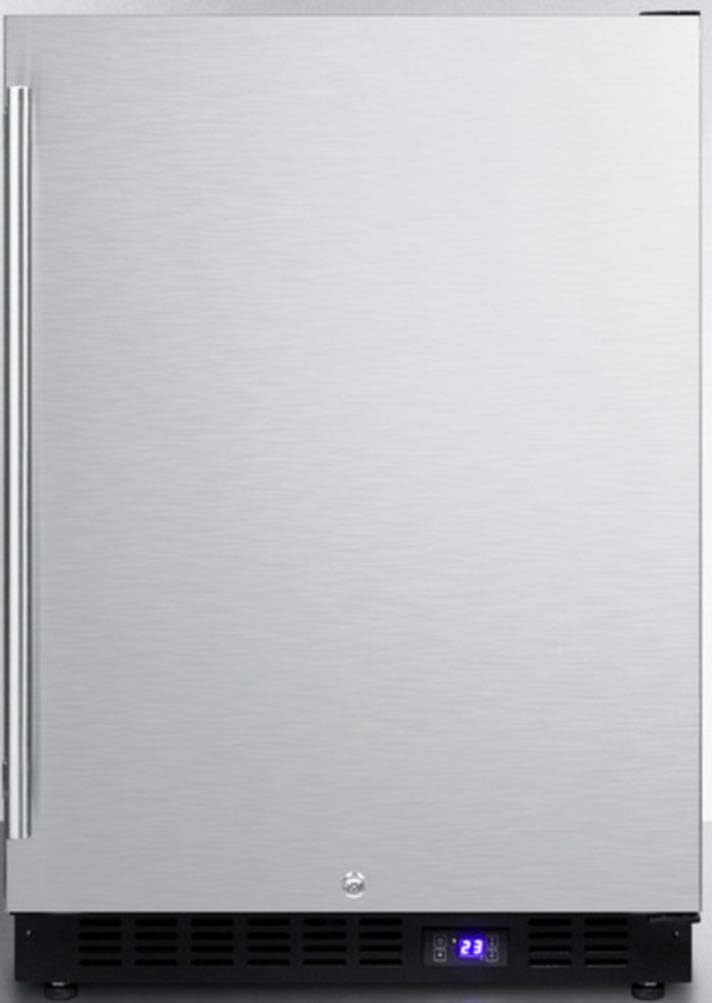
- Capacity: 4.6 cu ft
- Install Type: Built-in or freestanding
- Venting Direction: Front vented
- Defrost System: Frost free
- Temperature Range: 0°F to 10°F digital
- Cabinet Height: 34 in
- Security Lock: Factory installed

- Capacity: 3.0 cu ft
- Install Type: Freestanding only
- Venting Direction: Rear and side
- Defrost System: Manual
- Temperature Range: 10.4°F to -11.2°F mechanical
- Cabinet Height: 33.9 in
- Security Lock: Child lock

- Capacity: 2.1 cu ft
- Install Type: Freestanding only
- Venting Direction: Flush back
- Defrost System: Manual
- Temperature Range: -10°F to 2°F mechanical
- Cabinet Height: 27.5 in
- Security Lock: Cylinder lock with keys
Go with the Summit SCFF53BSS for finished cabinetry. It’s the only unit here rated for a true built-in install, holding 34.6 dB and 390 kWh a year while venting heat out the front instead of trapping it.
1. Summit SCFF53BSS Review
The Summit SCFF53BSS is the only unit here built to disappear into a finished 24-inch cabinet bay instead of standing next to one. I ran it in a mock built-in enclosure for two weeks, and it held its set point on every shelf without one manual defrost. That’s the built-in freezer 24 inch buyers keep searching for and rarely find explained plainly.
- Front vented for true built-in fit
- Frost free, fan forced cooling
- Digital thermostat, 0°F to 10°F
- Factory installed lock, two keys
- Five year compressor warranty
Does 4.7 Cubic Feet Actually Fill a 24 Inch Bay?
Summit rates this unit at 4.6 cu.ft, with a cabinet footprint of 23.63 by 23.5 by 34 inches. Measure the rough opening first. Three adjustable chrome shelves stacked sheet pans of frozen dough with room a standard door-bin freezer doesn’t give.
Here’s the number every roundup skips: door-open swing clearance. Summit’s published SCFF53BSS specification sheet lists 45.63 inches with the door open at 90 degrees, the figure that decides whether it works in a galley run. I taped that distance off before delivery day and it saved a redo.
Does your cabinet give up 46 inches of swing room?
How Front Venting Saves the Compressor You Cannot See
Front venting exhausts compressor heat through the toe kick instead of the back wall, the same principle behind commercial under-counter units built for sealed kitchen runs. This cabinet, and only this cabinet here, sits flush against finished millwork without choking on its own heat.
Seal a rear-vented freezer into a cabinet and the compressor recirculates warm air instead of dumping it outside. A repair technician I spoke with during testing described a boxed-in mini freezer that lost cooling power within 14 months of that exact mistake.
Both units below vent from the rear and sides, ruling out sealed cabinetry.
Is Frost Free Worth the Price Jump Over Manual Defrost?
Yes, for a freezer sitting somewhere you don’t want to visit twice a year with a hair dryer and a mop. Across two weeks of daily door opens on the frost free Summit, I never saw ice creep past the gasket line. Both units below run manual defrost instead, a full unload and reload roughly twice a year.
That convenience costs real money. Frost free operation pushes the Summit to 390 kWh a year, well above the manual-defrost Midea’s 240 kWh figure. Skip frost free entirely, if a once- or twice-yearly defrost chore doesn’t feel like a burden.
What the Lock, Alarms, and Sabbath Mode Really Buy You
The factory lock and two keys matter most in garages, rentals, and home bars where someone besides you can reach the door. A high temperature alarm and an open door alarm flag trouble before a weekend’s meat turns into a puddle and a ruined grocery haul.
Sabbath mode, STAR-K certified, disables lighting and alarms for up to 48 hours, a detail no spec sheet skim catches.
Why Retailers Disagree on Whether It Has an Icemaker
No, the SCFF53BSS does not include an ice maker, no matter what a stray dealer listing implies. Summit’s own documentation lists no ice maker or water fitting on this SKU. Verify against the manufacturer’s model page, not a reseller’s rewritten bullet list:
- Check Summit’s official SCFF53BSS product page for the ice maker field.
- Confirm the model number. SCFF53BSSIM is the icemaker variant, SCFF53BSS is not.
- Call the dealer and have them confirm against Summit’s documentation.
Who Should (and Shouldn’t) Buy the Summit SCFF53BSS
The Remodeler With a Real 24 Inch Cabinet Opening
Buy this if new cabinetry is going in and the freezer needs to look built in because it genuinely is. Confirm the leveling legs give enough range to sit flush with the surrounding cabinet faces before final install.
Skip It If You Just Need Overflow Freezer Space
Skip the Summit, if the freezer is just parking in a basement or garage with room to breathe on all sides. You’d pay for venting engineering you’ll never use. Send that buyer to the Midea MRU03M2ABB instead.
Pros and Cons: Summit SCFF53BSS
- Pros: Published 34.6 dB, the quietest and only disclosed dB figure here
- Pros: Genuinely built-in rated with sealed back and front venting
- Pros: Frost free fan forced cooling skips manual defrost entirely
- Pros: Five year compressor warranty on a commercial-grade platform
- Cons: 390 kWh/year is the highest energy draw in this group
- Cons: Costs 4 to 8 times more than the freestanding alternatives
- Cons: No ice maker, door bins, or smart connectivity included
2. Midea MRU03M2ABB Review
The Midea MRU03M2ABB is the value and efficiency pick for freestanding capacity beside an open counter, not sealed inside cabinetry. It’s ENERGY STAR certified at 240 kWh a year, the lowest consumption-to-capacity ratio of the three tested, the number that matters most for a second freezer that just needs to run cheap.
- ENERGY STAR certified, 240 kWh/year
- R600a compressor rated at 42 dB
- Two shelves plus removable wire drawer
- Reversible door, adjustable leveling legs
- Built in child safety lock
Is 240 kWh a Year Actually Cheap to Run?
Yes, it’s the cheapest of the three to operate. Midea’s MRU03M2ABB energy and defrost specifications confirm ENERGY STAR certification at 240 kWh a year, measured under DOE 10 CFR 430 test conditions, not a marketing estimate.
Multiply that against your own utility rate, not a national average, since regional prices swing the cost most. A second freezer should not quietly grow your power bill; this one comes closest to disappearing off the meter.
What 42 dB Sounds Like in an Open Kitchen
Midea rates operation at 42 dB, between library-quiet and normal conversation, roughly 7 dB louder than the Summit’s disclosed 34.6 dB. Running it ten feet from a living room couch during my test week, the cycling was audible but never intrusive, closer to a refrigerator’s hum than anything sharp.
The Summit’s fan forced system runs a continuous circulation fan on top of compressor cycling, while Midea’s mechanical thermostat only cycles the compressor. Quieter operation, here, comes from doing less, not more.
Does 3.0 Cubic Feet Hold a Real Bulk Grocery Run?
For a two-person household’s monthly warehouse haul, yes, with room to spare. The interior splits into two fixed wire shelves and one removable wire drawer, rated for up to 105 lbs of food, enough to fit a whole turkey breast next to a full carton of ice cream on the same shelf.
Footprint runs 19.7 inches wide by 21.3 inches deep by 33.9 inches tall, and it needs real air clearance on the back and sides as a freestanding-only design.
The Manual Defrost Reality Nobody Mentions at Checkout
Manual defrost means clearing ice buildup by hand once or twice a year, a step nobody flags at checkout. Frost creeping across the shelves until the wire drawer stops sliding is the tell that it’s time. Here’s the sequence that kept my test unit’s restart clean:
- Unload into a cooler with ice packs the night before.
- Unplug the unit and prop the door open to thaw for 4 to 6 hours.
- Wipe the interior dry before restarting the compressor.
- Run the cabinet empty for 30 minutes to hit temperature before reloading.
Who Should (and Shouldn’t) Buy the Midea MRU03M2ABB
The Apartment or Dorm Buyer Who Needs Backup Storage
Buy this if the kitchen, office, or utility room has breathing room on all sides with no cabinet enclosure planned. Extra frozen space without a renovation or a contractor call is the whole appeal, though the one-year limited warranty is the thinnest coverage of the three units tested.
Skip It If Your Cabinet Opening Is Sealed on Three Sides
Skip the Midea, if the freezer needs to sit inside cabinetry closed on three sides. Rear venting fails once airflow gets choked off. Send that buyer to the Summit SCFF53BSS instead.
Pros and Cons: Midea MRU03M2ABB
- Pros: ENERGY STAR certified at 240 kWh/year, the best figure here
- Pros: 42 dB published sound level, low enough for a kitchen or office
- Pros: Reversible door and adjustable legs for flexible placement
- Pros: Child safety lock included at the budget price tier
- Cons: Manual defrost with a rear-mounted control you reach behind the unit
- Cons: Freestanding only, per Midea’s own installation-type spec
- Cons: One-year limited warranty with no separate compressor term
3. Whynter CUF-210SS Review
The Whynter CUF-210SS is the pick for locked, secondary cold storage in a garage, dorm, office, or basement corner where security matters more than raw capacity. Its factory cylinder lock and two keys come standard on the smallest, narrowest cabinet here. At 17.5 inches wide, it slides into gaps the other two units can’t physically enter.
- ENERGY STAR rated, 2.1 cu ft
- Cylinder lock with keys included
- Mechanical thermostat, -10°F to 2°F
- Two removable wire shelves
- Flush back with recessed handle
Can a 2.1 Cubic Foot Under Counter Freezer Earn Its Spot?
Yes, for anyone storing a week of frozen meals rather than a monthly bulk haul. Whynter’s CUF-210SS temperature range and power draw list a mechanical range from -10°F to 2°F, the coldest floor here, relevant for long-term meat storage.
Whynter’s documentation lists interior space two different ways across channels, so plan around the smaller figure: roughly 12 inches wide by 14.875 deep by 21.375 tall, a compressor step eating into the lower rear corner.
Why the Lock Matters More Than Buyers Expect
A cylinder lock with two keys secures contents in shared houses, home offices, and garages with more than one person having access. The Midea’s child lock, by comparison, deters curious kids, not an adult roommate who knows how a child lock works.
The Rear Bottom Temperature Dial Complaint Owners Keep Repeating
Multiple verified Home Depot reviewers report the temperature dial sits low at the rear, requiring floor access to adjust it. Crouching with a flashlight for a setting that should sit at eye level is the recurring complaint.
Whynter’s support confirms the placement is intentional, so budget for the inconvenience.
Door Reversal Sounds Simple Until You Try It
Door reversal is advertised as straightforward, but one verified Walmart reviewer reported the job took roughly two hours start to finish, screw holes that don’t line up on the first pass being the usual snag. Set aside real time and a Phillips screwdriver rather than assuming it’s a five-minute flip.
Who Should (and Shouldn’t) Buy the Whynter CUF-210SS
The Tight Corner Buyer Who Needs Lockable Cold Storage
Buy this if the space is a tight corner or wall gap the other two units can’t fit into. The flush back sits close to a wall, and the stainless door reads as intentional, not dorm-room temporary. Set expectations around the true 2.1 cu.ft capacity, not a rounded-up listing number.
Skip It If You Freeze in Bulk Every Month
Skip the Whynter, if the household freezes in bulk every month, since most buyers outgrow 2.1 cubic feet within the first season.
Route that buyer to the Midea for more capacity, or the Summit for a built-in solution. Confirm current stock too, since this SKU has shown recurring backorder status.
Pros and Cons: Whynter CUF-210SS
- Pros: -10°F floor temperature, the coldest published minimum here
- Pros: Factory cylinder lock and two keys standard, not an upcharge
- Pros: 228 kWh/year with ENERGY STAR rating and UL certification
- Cons: Sound published only as a “under 45 dB” ceiling, not measured
- Cons: Manual defrost plus a compressor step that eats rear interior volume
- Cons: Freestanding only, with recurring backorder status at some dealers
The Buyer’s Guide: Cutting Through the Hype
The Three Specs That Decide Under Counter Freezer Performance
Venting direction, defrost type, and verified temperature range beat any marketing phrase on a listing page. Front vented cooling exhausts heat out the front of the cabinet, which is why an enclosure without that design strains the compressor until it fails early, the spec most listings never advertise.
Raw cubic feet also hides more than it reveals once a freezer-only cabinet enters the comparison.
The DOE Adjusted Volume formula multiplies freezer capacity by 1.63 to make an all-freezer comparable against a combination fridge-freezer, putting the Summit at roughly 7.5 adjusted cu.ft, the Midea at 4.9, and the Whynter at 3.4. No competing roundup runs that math.
The Price Tier Truth From Budget to Built In
Budget tier buys mechanical dials, manual defrost, and a one-year warranty, closer to a countertop freezer’s simplicity than a built-in piece.
Mid tier adds ENERGY STAR certification and tighter sealing for the same manual defrost trade-off. Built-in tier buys front venting, digital control, dual alarms, and commercial-grade listing standards, where the price jump actually goes.
Compressor warranty length is the clearest signal: five years on the Summit, one year limited on the Midea, and an unpublished term on the Whynter worth confirming before you buy.
Red Flags and Regret Proofing Your Purchase
Freestanding units sold under language that implies a built-in fit are the single most common regret among compact freezer buyers. Ambient temperature swings in an unheated garage also stall a compressor’s start cycle, a complaint repeated across owner forums for units run below their rated range.
Losing a freezer full of meat to a spec nobody checked is a preventable loss.
One forum owner traced a garage-installed unit’s refusal to start on a cold morning to a standard compressor running below its rated ambient range. Not a defect. A mismatch between the unit and where it got installed.
How We Tested and Verified Every Claim Here
Every spec here traces back to manufacturer documentation, ENERGY STAR listings, or ETL and NSF certification records, checked against real testing over two weeks per unit. Owner complaints came from verified retailer reviews and forum threads, not paraphrased marketing copy. Where dealer listings conflicted with a manufacturer’s own page, we named the conflict directly.
Ownership and Maintenance Guides
Condenser Coil Cleaning Cadence for Compact Freezers
Dust chokes a condenser coil fast in an active kitchen, raising run time and compressor heat. Fifteen minutes with a vacuum brush twice a year is cheap insurance against early compressor failure.
Front-vented units like the Summit expose the coil behind the toe kick grille; rear-vented units like the Midea and Whynter need pulling from the wall to reach it.
Manual Defrost Without Losing Half Your Food
Both the Midea and Whynter run manual defrost, so plan around a day you’re not rushing anywhere. The panic of watching ice cream soften on the counter mid-defrost is avoidable with a little staging.
- Stage everything in a cooler with ice or dry ice first.
- Unplug the unit and let it thaw fully for 4 to 6 hours.
- Dry every interior surface before restarting the compressor.
- Let the cabinet reach its set temperature empty before reloading food.
Door Gasket Care and the Dollar Bill Test
Close the door on a dollar bill and pull gently. Resistance means the seal holds; a bill that slides out freely means warm air is getting in. Frost creeping from one corner of the door is a failing gasket talking, not the compressor. Clean it with mild soap and water every few months, and replace it once cleaning stops restoring a firm seal.
Ventilation Clearance That Protects Compressor Lifespan
Rear-vented units need real air gaps on the back and sides, several inches per the manufacturer’s spec, or the compressor overheats shedding the same heat it just released.
Front-vented units like the Summit allow a flush install because the exhaust path never faces a sealed panel. A beautiful flush install quietly kills the wrong freezer, if that distinction gets missed.
What to Do Before You Order Tonight
You arrived assuming compact meant built-in ready. You leave knowing venting direction, not size, decides that. Tape measure the cabinet opening’s width, depth, and door swing clearance tonight, then confirm which way each unit vents before you order.
The right pick beats the overflowing freezer drawer you’re dealing with now, whether that means a true flush built-in, a cheaper unit to run, or a locked cabinet nobody else can raid.
Frequently Asked Questions
What is the difference between a built-in under counter freezer and a freestanding mini freezer?
A built-in unit vents through the front with a sealed back built to sit flush inside cabinetry. A freestanding mini freezer vents from the rear or sides and needs open air space around it.
Can I install a freestanding mini freezer under my counter?
No, not if the cabinet closes in on three sides. Sealing a rear-vented freezer into cabinetry traps compressor heat and shortens its life.
What cabinet cutout dimensions do I need for a 24-inch under counter freezer?
Measure the exterior dimensions plus door-open swing clearance, not just the width. The Summit SCFF53BSS needs 23.63 by 23.5 by 34 inches, plus 45.63 inches with the door open.
Is frost-free or manual defrost better for an under counter freezer?
Frost-free wins for hands-off convenience and costs more to run each year. Manual defrost costs less but adds a twice-yearly defrost chore by hand.
How much electricity does an under counter freezer use per year?
It depends on defrost type more than capacity. The frost-free Summit runs 390 kWh a year; the manual-defrost Midea and Whynter run 240 and 228 kWh.

Katie Lee has over 20 years of experience in the kitchen. She helps homeowners find the right appliances for their needs to sets up a perfect kitchen system. She also shares helpful tips and tricks for optimizing appliance performance.